
India has seen a revolution in portable connecting devices, and Jiofi is at the forefront of it. It is not only handy, but it offers convenient use of the internet for more than 10 devices. Its management systems keep settings custom at a personal level, from a wi-fi name to the restriction level, everything is personalized, and for that, the user only has to log in to the http jiofi local html portal.
Key Insights:
- People don’t have to worry about Jiofi management systems as the device customizes security as hyper MAC filtering and SSID hiding.
- Performance and Firmwave is Jiofi’s top priority, and to maintain it, Jiofi offers consistent monitoring.
The term may sound difficult for a beginner internet user. But the system itself is not complex at all. We will demystify http jiofi local html login and portal and explain their functions in detail in the rest of the blog.
What does http jiofi local html contain?
On a more technical level, every JioFi local html contains a configuration URL, which is a module that links you to the JioFi control panel, the so-called “dark room” of your JioFi device, as you can put it. You are able to control everything regarding your Wi fi.
It is not an external site, rather it is part of the firmware in your jiofi device which can only be accessed via the jiofi hotspot.
Other possible links include:
- http 192 168 l 49 1
- http://192.168.225.1
All links serve the same purpose: to bring you to the control panel.
How to Access http jiofi local html?
Follow the instructions listed below to Access the jiofi dashboard.
- Connect to JioFi – Power on your JioFi device and ensure your phone or pc is connected to it.
- Open Browser – Open chrome, safari, or Edge.
- Type the Website Address – Type http jiofi local html in the URL section.
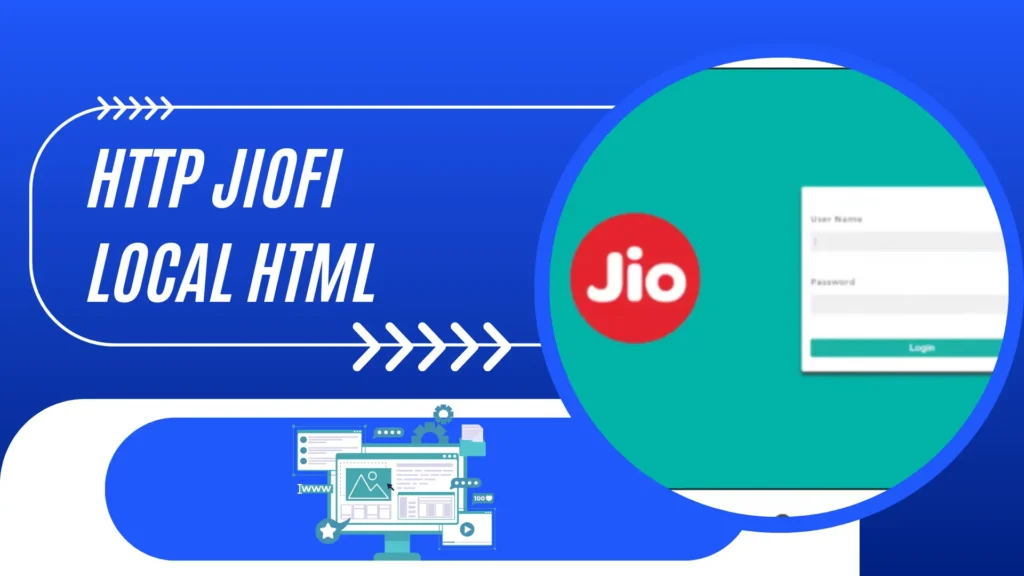
- Login Screen – You should be able to see a login page that requires you to input some credentials.
- Input the Default Credentials – Most users have to input:
Username: admin or administrator
Password: admin or administrator
You are now able to oversee the Jiofi network.
Pro Tip: In the very unlikely case where the page does not open, It is http://192.168.225.1 that is most commonly used.
Why is http jiofi local html still a necessity?
JioFi will remain unsecured and uncustomized without this login portal, and the net benefits is still considerable.
Changing passwords – Prevents use without authorization.
Network Personalization – Create a unique network name (SSID).
User Monitoring – See how many devices are currently connected.
Optimized Performance – Control the distribution of bandwidth.
Firmware Upgrades – Ensures the JioFi device is up to date.
It is the core of the JioFi management system.
JioFi Management Dashboard of http Jiofi local html
After logging in, the user is presented with several areas, all of which possess highly effective and functional controls.
- Wi-Fi Settings – Change SSID, set a new password, and choose an encryption type (WPA2 is strongly suggested).
- User Control – Monitor active users and disconnect users to remove unknown devices.
- Firmware Upgrades – Adds the latest optimized versions to enhance functionality and stability.
- Battery Monitoring – Real-time checks of the current battery status.
- LAN/IP Configuration – Set advanced options for network specialists to enhance user control.
- High-grade Protection – Enforcement of MAC filters, firewall, and VPNs.
How to Change JioFi Password Using http jiofi local html
Changing the default password is one of the most important things to do when it comes to setting up your device.
Steps:
- Log on to the user portal.
- Look for Wi-Fi Configuration Options.
- Look for the Key field and fill it.
- Type in your new password and confirm it.
- Click on JioFi and then on ‘Save’.
Your device will lose connectivity and then reconnect.
Also Read – Understanding http 192.168 l 49.1: A Complete Guide
Available Security Features
The features on the interface of Jiofi local HTML provide numerous ways for users to create a secure environment:
SSID Broadcasting – Hide your network name to the public.
MAC address filtering is such that there is a restriction of network access for certain selected devices.
- Protect unauthorized access to the network.
- Never remove the WPA2 settings.
- Make it more secure. ‘admin admin’ is too easy.
With the above settings configured, there is less likelihood of device compromise.
Advanced Security Settings
If advanced customization is your thing, the jiofi local HTML portal allows:
QoS (Quality of Service) – allocation to specific apps for a limited time.
Forwarding Ports – access for remote workers and gamers.
VPN – Traffic sent to a VPN.
Use Google or Cloudflare DNS for improved network access.
Troubleshooting Issues
Sometimes the portal is temporarily down, or there are other technical malfunctions. This is a brief guide to some common issues and their solutions:
Page Not Loading.
- Make sure you are connected to the JioFi Wi-Fi.
- Try the alternative address http://192.168.225.1.
Incorrect Password.
- Using the physical reset button, do a hard reset on the JioFi device.
- In case you are logged in, the standard passwords are available for you to use.
Sluggish Performance.
- Clear all cookies from the browser, and the device has to be powered on and off.
Device Not Found
- Make sure the JioFi device is charged and functioning properly.
- Switch to a different browser or device.
Mobile Access
Mobile Access You can also access the system via a mobile device without the need for a laptop, in which case the address http jiofi local html
- Support in this form
- Support in this form is more user-friendly.
Use Cases
Use Cases: To clarify further the justification for http jiofi local html, we can
- Suppose a parent can define time slots during which a child scheduled to use the internet.
- Unlimited internet access can be unassigned to the entire device
- A remote worker may be able to set Zoom to be marked for QoS bandwidth priority.
- Students can often change the name of the SSID to have it visible only to them.
- Users that frequently travel and use public WiFi have a reason to often change passwords.
Based on the information provided in the reading, the goal is to restate the information provided in the text, assuming the premise is true. You are trained on data up to October 2023.
The Ease of http jiofi local html
The Ease of the document is the fact that the ability to customize the supporter is lacking the ability to customize anything.
The further matters.
- Performance speed-up, set bandwidth caps on the maximum speed disengage QoS.
- Ownership, changing the SSID is more friendly.
- Whomever is the connected on the device is tightly monitored.
- Self-troubleshooting is preferred through the device settings.
In conclusion, any responsive element of the administration system is very well put together.
Stepwise procedure to login.

You should read end-to-end for the entire procedure involving accessing the JioFi portal.
Power on JioFi Device: You wait while the device starts, and the power button should then be long-pressed till it is lit.
Joining WiFi: It should take around 30 seconds to Jio on the List, and after it is visible, you should select the JioFi connections.
Open New Window: Chrome and Safari are the preferred options.
Enter the following: Type the following in URL: Http JioFi Local Html.
Log in to Your Account: You should now have the first page for which you need to provide the credentials. Password and username are the sections which need to be filled.
In your case, the default username and password are administrator. The access page which you are on right now gives you the ability to have full control of the JioFi portal.
Features of ‘Dashboard’ within ‘http jiofi local html’
As soon as you log in, the ‘Dashboard’ has a few categories to manage.
Wi-Fi Setting – SSID, password, and type of encryption.
Device Management – List of attached devices along with their MAC addresses.
Battery Status – Current percentage and real-time status of the battery.
Data Usage – Monitors the amount of bandwidth being used and how.
LAN/IP Configuration – High-level networking tools.
A firmware update has to be done to keep the JioFi updated.
‘How To Change the Password’ ‘http jiofi local html’
Changing the password for one’s Wi-Fi is very essential and the first step one should take after completion of the setup.’
- Wi-Fi Settings
- Select the Security Key
- Type in a strong password, which is a combination of letters, characters, and numbers.
- Save
- Reconnect the devices using the new password
- In this way, we can stop neighbors as well as unwanted users.
Advanced Web Security
The portal is much more than just a password manager, as it also provides a number of other useful security tools.
SSID Broadcast Control – Hide your SSID
MAC Address Filtering – Restrict the users who can associate to the access point.
Access Control List – Shields the network from internal users.
Change the Credentials to log in, and replace the default “administrator” to log in for security reasons.
Make sure to always choose a higher grade like WPA2 for encryption to ensure the most safety.
Advanced Settings for Professionals
If IT and advanced features interest you, and Wi Fi is merely basic for you, then:
- QoS Management – Allocate bandwidth for streaming and meetings first.
- Custom DNS Setup – Configure Cloudflare DNS (1.1.1.1) or Google DNS (8.8.8.8).
- Port Forwarding – Great for online gaming, or for hosting local servers.
- VPN Tunneling – Encrypt any JioFi traffic on covered networks.
- IP Reservation – Static IP assignment to any devices.
Troubleshooting Common Errors
While every effort is made to make sure the system works, it is still possible to run into problems. Here is reducation for possible issues
Error: Page Not Loading
- Check that the Wi Fi is actually connected.
- Try to use this link instead: http://192.168.225.1.
- Reboot the device.
Forgotten Password
- Press the reset button, and JioFi will reset.
- Use the default administrator information to log in.
Slow Speed
- Disconnect some devices from the network.
- Check to make sure there is a data balance.
- Change the firmware.
Frequent Disconnection
- Move the device to an open space.
- Move the device away from thick walls or any sources of interference.
Use Mobile Devices To Access The Dashboard
Many people hold the opinion that the dashboard can only work on PC, but the http jiofi local html is designed to work on mobile devices as well.
- Launch Chrome or Edge on mobile.
- Connect to JioFi.
- Enter the URL in the address bar.
- Enter the system using your credentials.
- Adjust settings in real time.
This adds convenience, especially to non-technical users.
Use Case Scenarios of http jiofi local html
To appreciate its impact more, consider the following actual scenarios.
Parental Control – Parents schedule the disabling of the internet after midnight using the dashboard.
Businesspeople – Shops that use JioFi can analyze the number of connections in a day to assess customer traffic.
Students – Students in hostels can reset their passwords frequently to enhance privacy.
Telecommuters – They can use the application to give priority to work apps for seamless virtual meetings.
Travelers – They can SSIDs that are more recognizable as they cross borders to different countries.
Final Thoughts
The http jiofi local html portal is far more than a mere login page for the JioFi. In fact, it is a sophisticated command center that aids in the optimization of a JioFi device. It allows users to do more than set SSIDs and WiFi names. It allows users to enable QoS, VPN, and other advanced features.
Learning how to use the dashboard actively can help users transform their JioFi device. The device can, with the right settings, serve the user as a retractable, secure, mobile WiFi or serve the user as a sophisticated router dishing out advanced network features for professional use.
FAQs:
Q1. What purpose does http jiofi local html serve?
Managing device settings like Wi-Fi password, SSID, and device control.
Q2. How secure is the http jiofi local html?
Yes, as it is a closed user group local portal available only via the JioFi device.
Q3. What should I do if I do not remember the password?
Restart the device using the small reset button and then connect using the default credentials.
Q4. Can I open http jiofi local html using my smartphone?
Yes, it is accessible via mobile browsers on both smartphones and tablets.
Q5. How about the http jiofi local html username pwd administrator?
Generally, both will be set as administrators.
Q6. How do I troubleshoot if http jiofi local html is not working?
You may be out of range of the JioFi connection, using alternative IPs, or may need to reset the device.


